5 UPI Mistakes That Can Cost You Money
5 UPI Mistakes That Can Cost You Money
Standing in a long queue to pay the electricity bill, I had never imagined that one day I would be able to make the same payment with just a few clicks while sitting comfortably in my AC room.
All thanks to UPI payments!
Today, I cannot even imagine going back to those days again. UPI has truly proved to be a boon, making life far easier and more convenient than ever before, and we are genuinely thankful for this innovation.
But every convenience comes with its own risks. UPI payments have become a huge part of our daily lives, but along with this ease comes the responsibility of keeping our transactions safe. After all, everything in the world has its own pros and cons.
Coming to the most common UPI mistakes that can quietly exhaust your bank account and How to avoid UPI scams -
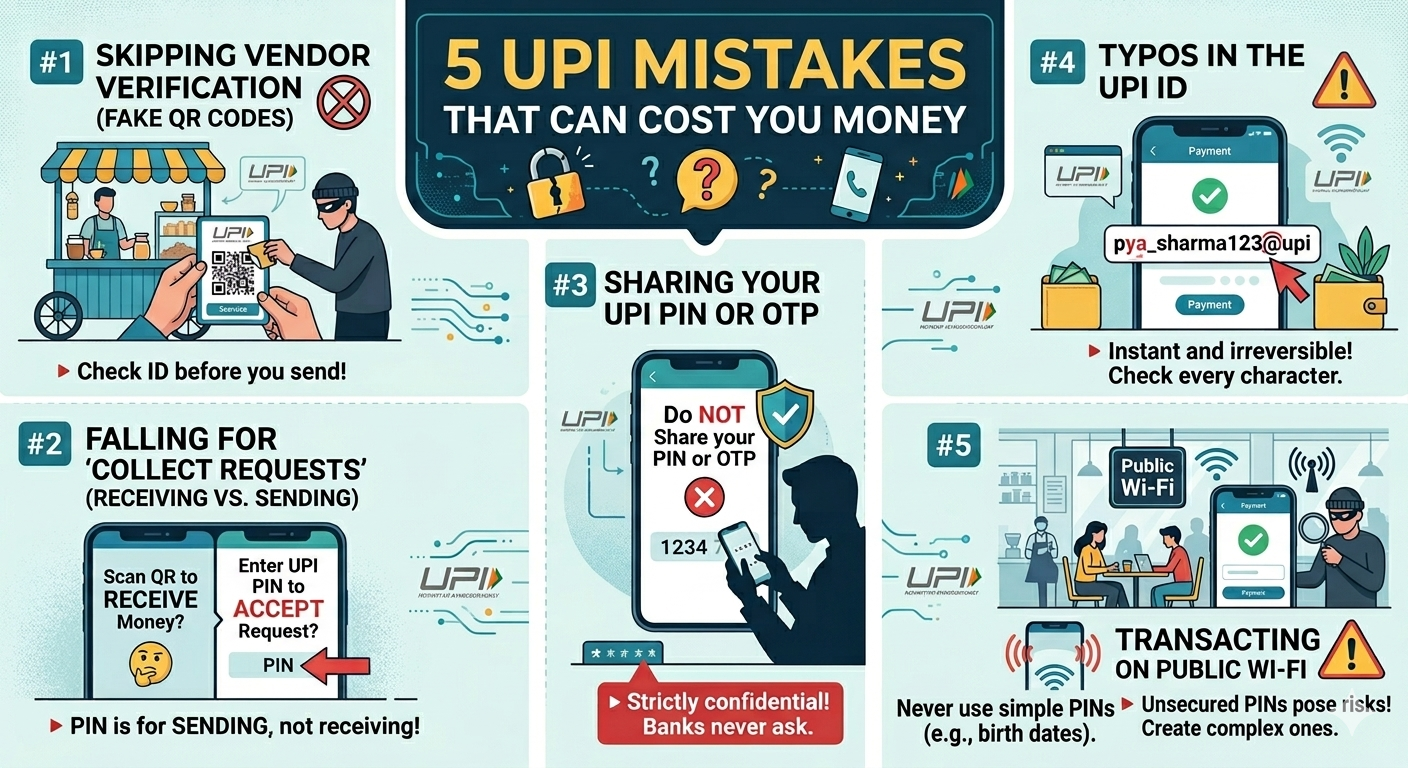
1. Scanning QR Codes and Making Payments Without Checking the Vendor’s Name
It has become a habit for most of us to make payments without even checking the name of the person we are paying to. Because of this, fraudsters have found a new technique, sticking fake QR codes over the original ones so that the payment gets transferred to their account instead.
This has become quite common, especially in crowded places like tea stalls and small vendor shops.
Insight – Always recheck the name of the person you are making the payment to.
2. Accepting Money Requests Instead of Sending
This is something I myself almost got trapped in.
I had installed OLX to sell one of our old pieces of furniture, and as soon as I posted the ad, I started receiving calls. Since it was my first time selling something online, I was naturally a bit cautious.
One particular buyer surprised me. He was ready to make the payment immediately without negotiating even a single rupee and without even visiting my house or checking the item first. He said he would make the payment right away and collect the furniture later.
Honestly, that sounded strange to me. Still, I shared my number and asked him to transfer the payment. But instead of paying directly, he said, “I am sending you a QR code. You just have to scan it to receive the payment.”
For a moment, I was actually about to do it because everything seemed to be going very smoothly, and it was my first online sale experience. But then, something suddenly clicked in my mind. I paused and realized that something was not right.
I immediately insisted that he transfer the amount directly to my UPI ID instead. The moment I said that, he stopped replying to my messages.
That was the moment I understood how cleverly these fraudsters try to trap people, especially those who are not fully aware of how such scams work.
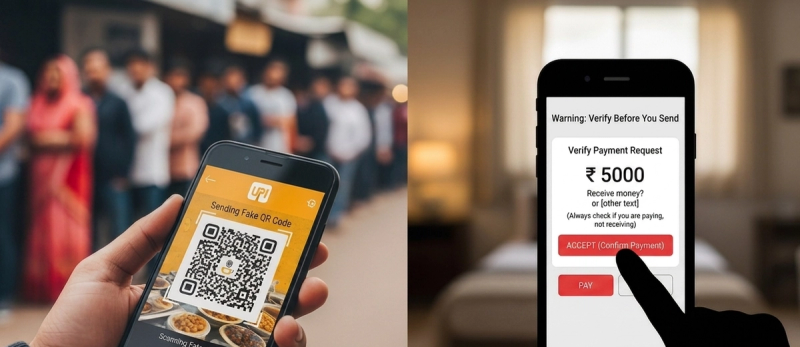
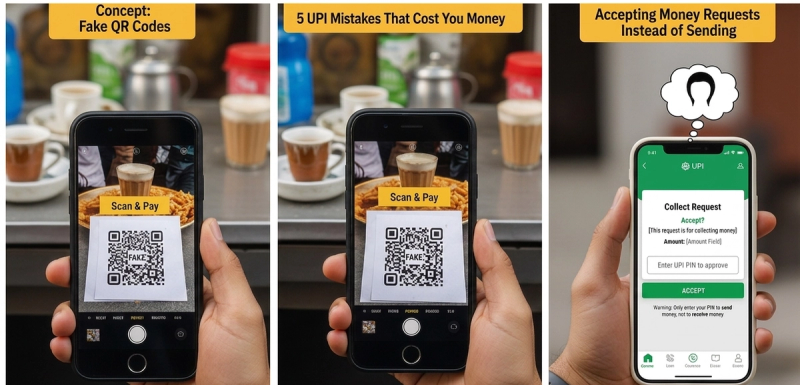
This is a common trick scammers use. They send a “collect request” on UPI, which looks very similar to a payment request. You enter your PIN thinking you are receiving money, but in reality, you are approving a payment from your own account.
Insight – You never need to enter your UPI PIN to receive money. If someone asks you to do that, it is a scam.
3. Sharing Your UPI PIN or OTP
As per the strict instructions of RBI, people should never share their UPI PINs or OTPs with anyone. This has been advertised everywhere through calls, television channels, newspapers, and digital campaigns to spread awareness about such frauds.
Still, many people fall into these traps and end up sharing their PINs. Once a fraudster gets access to your UPI PIN, they can easily empty your bank account.
Insight – Never share your UPI PIN or OTP with anyone under any circumstances, even if the person claims to be from your bank.
4. Entering the Wrong UPI ID
Always remember that UPI payments are instant and non-reversible. There is no buffer time for the bank or anyone else to correct the mistake. Hence, you need to be extra cautious before entering a UPI ID.
A small spelling error can transfer the payment to someone else’s account, and there is very little chance of getting your money back unless the receiver honestly returns it.
Insight – Always cross check the UPI ID and the receiver’s name before making the payment.
5. Using UPI on Public Wi-Fi
Public Wi-Fi is highly appreciated because it offers convenience to people, but at the same time, it also comes with risks. Public networks can sometimes become easy targets for hackers trying to access personal data.
Hence, it is always advisable to avoid making financial transactions over public Wi-Fi. If it ever becomes necessary, make sure to use a trusted VPN service like NordVPN or ExpressVPN before opening your payment application.
Insight – Try to use mobile data while making UPI transactions whenever possible.
A Small Check Can Save Your Money
UPI is truly one of the best payment methods available today, but it works best when used with a few precautions.
Online payment fraud prevention doesn't require a finance degree, just the right habits. From QR code payment scams to fake collect requests, real UPI fraud examples show us that scammers rely on split-second carelessness.
Follow these UPI payment safety tips, stay updated on UPI fraud awareness, and share these safe UPI transaction tips with anyone who taps "Pay" without thinking twice. Because avoiding common UPI mistakes is the simplest form of UPI scam protection.
Stay sharp, stay secure!!